Throughout his career, he has been fortunate to meet leading figures in their fields. Below are photographs with some of them: role models whose work continues to open up new ways of seeing and new possibilities.
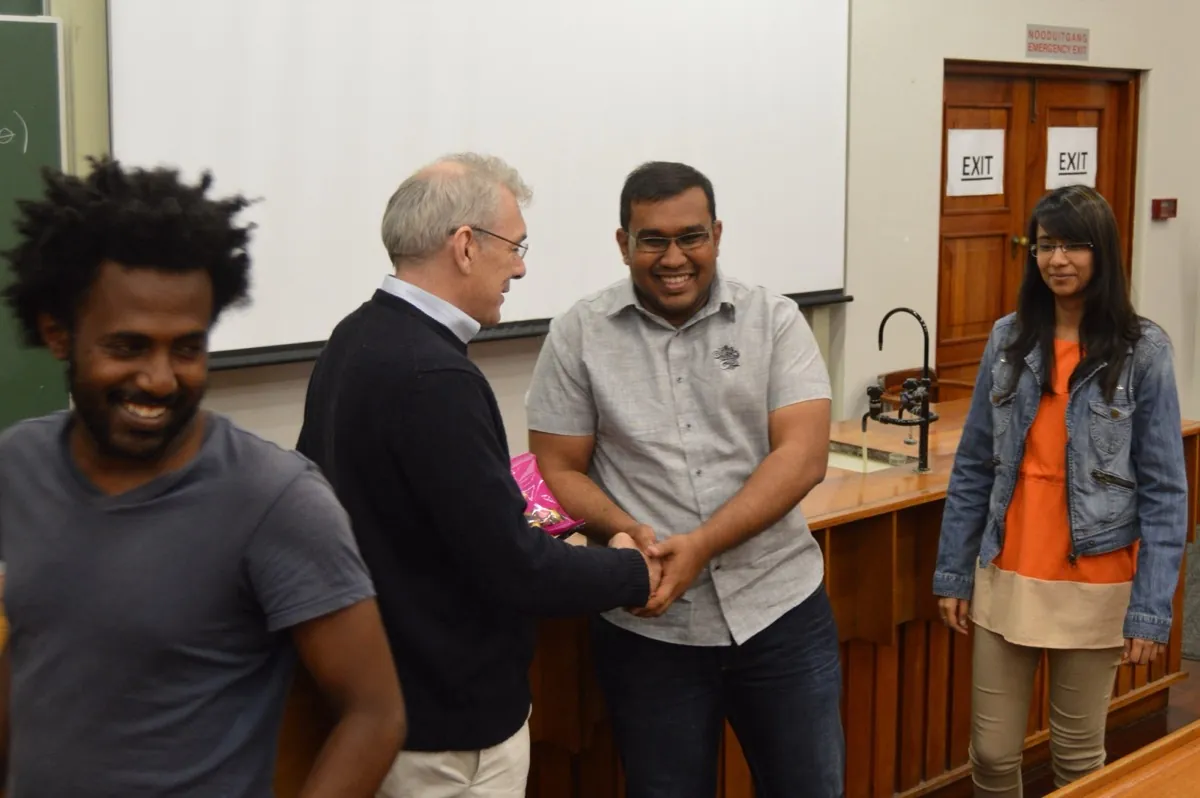
Prof. Alan Heavens was his PhD supervisor. They first met at the COSMO21 workshop in Greece in May 2016, and again at the Bayesian School in Stellenbosch, South Africa, in November 2016. Alan's work applies Bayesian statistics to cosmological data in order to extract the maximum possible information from it. He is the originator of the MOPED data compression algorithm, which is widely used in cosmology and has also been applied to medical image analysis. He has pioneered other research areas, including 3D weak lensing and Bayesian Hierarchical Models (BHMs). He worked with Alan on MCEvidence, a method for computing the Bayesian evidence of a model directly from existing MCMC samples.
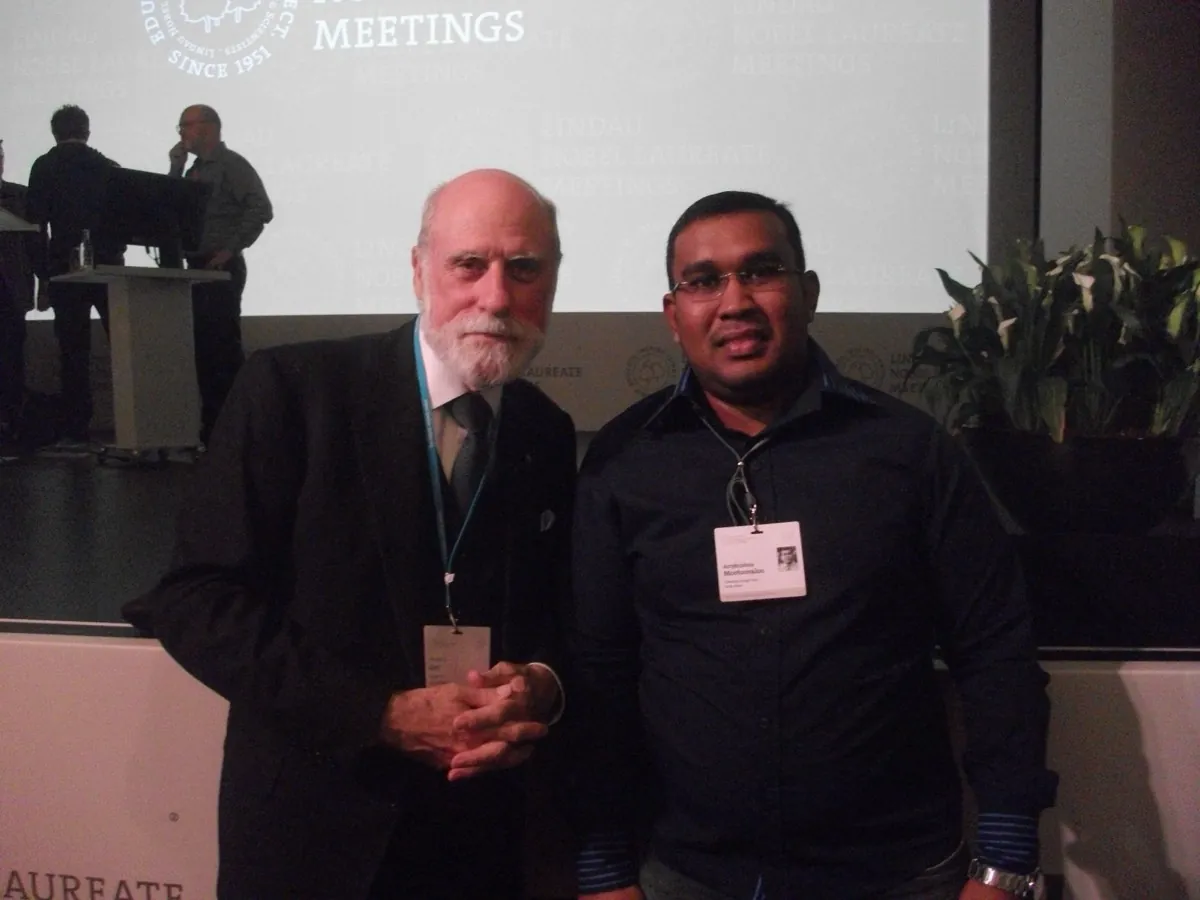
Vinton Cerf, widely regarded as one of the fathers of the internet, is Vice President and Chief Internet Evangelist at Google. He received the 2004 Turing Award, jointly with Robert Kahn, for their work on internetworking. More recently, he has pioneered the development of an interplanetary internet, which is essential for future crewed missions to other planets. The challenge is considerable: signals are limited by the finite speed of light, the distances between transmitter and receiver are vast and constantly changing, and the continual motion of the planets means that conventional point-to-point communication no longer works. Speaking at the Heidelberg lecture series, Vint remarked: "I won't live to see the particular end of this project, but if you get to start something and be part of it, even if you can't see the end of it, it's really cool, and that's how I feel about the internet and its interplanetary extension."
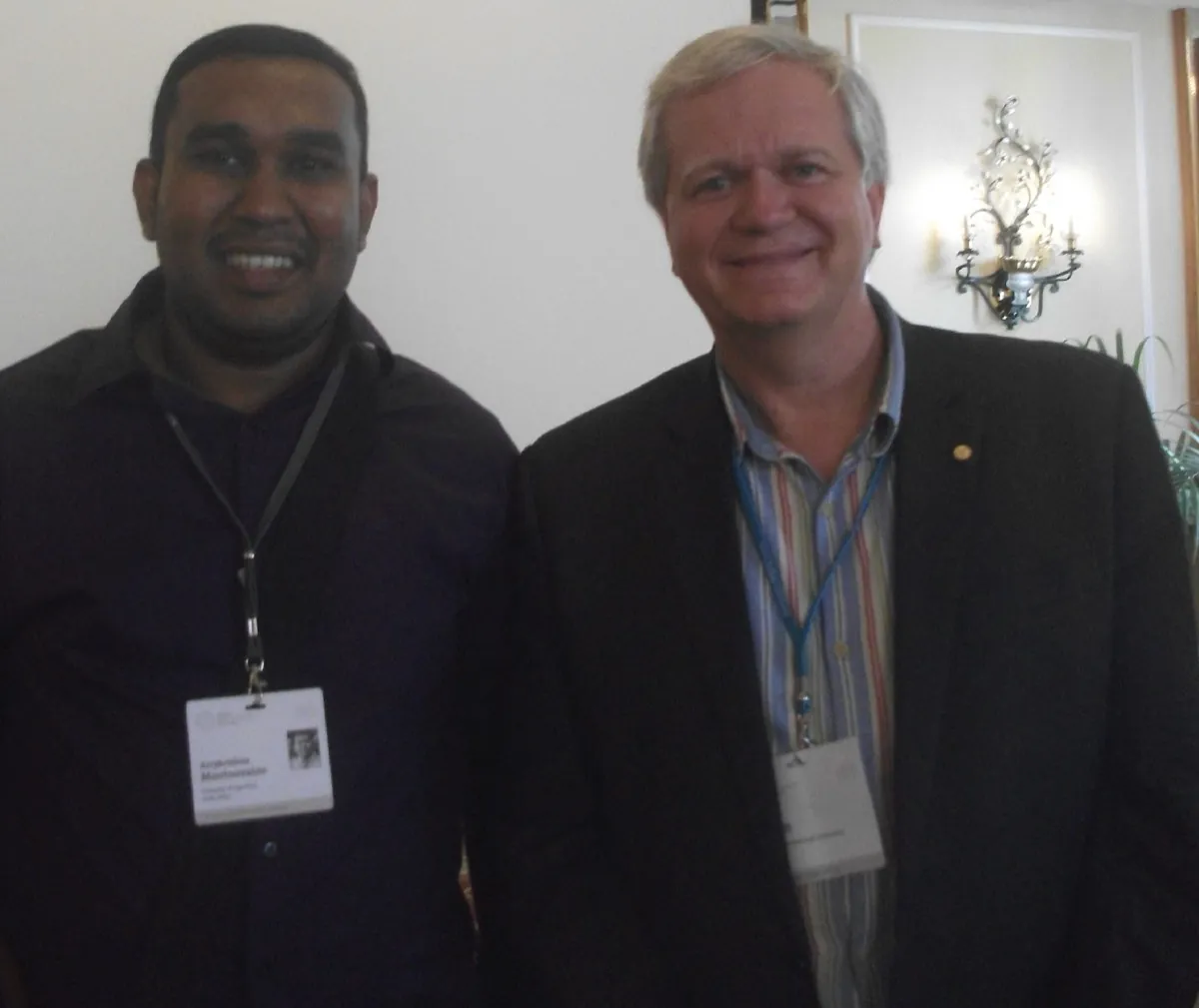
He also spoke briefly with Prof. Brian Schmidt, who shared the 2011 Nobel Prize in Physics with Adam Riess and Saul Perlmutter for the discovery of the accelerating expansion of the universe. He completed his PhD at Harvard University, with a thesis on measuring the Hubble constant using Type II supernovae. He went on to lead the High-Z Supernova Search Team, which set out to measure the expected deceleration of the universe using Type Ia supernovae. Unexpectedly, the team found that the expansion is accelerating rather than decelerating. The result was initially thought to be an error, but it was independently confirmed by Saul Perlmutter's Supernova Cosmology Project. Beyond his research, Brian is a strong advocate for science, supporting public education and scientific and medical research, and he is engaged with issues surrounding the climate crisis.
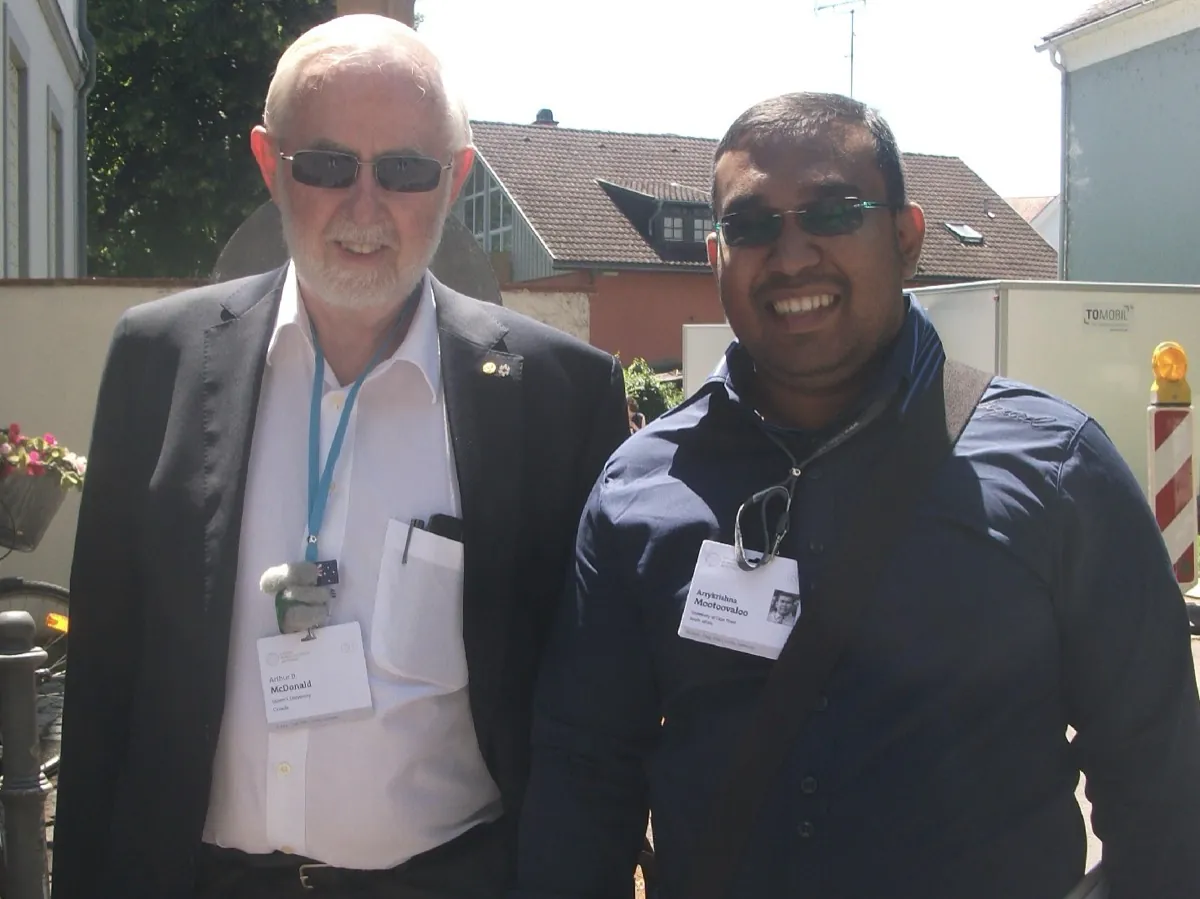
Prof. Arthur McDonald is a Canadian astrophysicist who shared the 2015 Nobel Prize in Physics with Takaaki Kajita for the discovery of neutrino oscillations, which showed that neutrinos have mass. Inspired to study physics by his high school teacher and his first-year physics professor, he completed his PhD at the California Institute of Technology in 1969. His research investigated whether neutrinos have mass, using heavy water as a detector for solar neutrinos. Since the outbreak of the COVID-19 pandemic in 2020, Arthur has also led a project to mass-produce low-cost ventilators, drawing on techniques from particle physics experiments to meet the required specifications. The project was supported by Canadian Prime Minister Justin Trudeau, and each ventilator can be built for under $1,000.