Emerging Trends in AI and Online Education
Andrew Ng at Imperial on narrow AI, small data, jobs and education.
Today, Professor Andrew Ng visited Imperial College London, both as a speaker in the Distinguished Lecture programme of the Data Science Institute (DSI) and to mark the DSI's fifth anniversary.
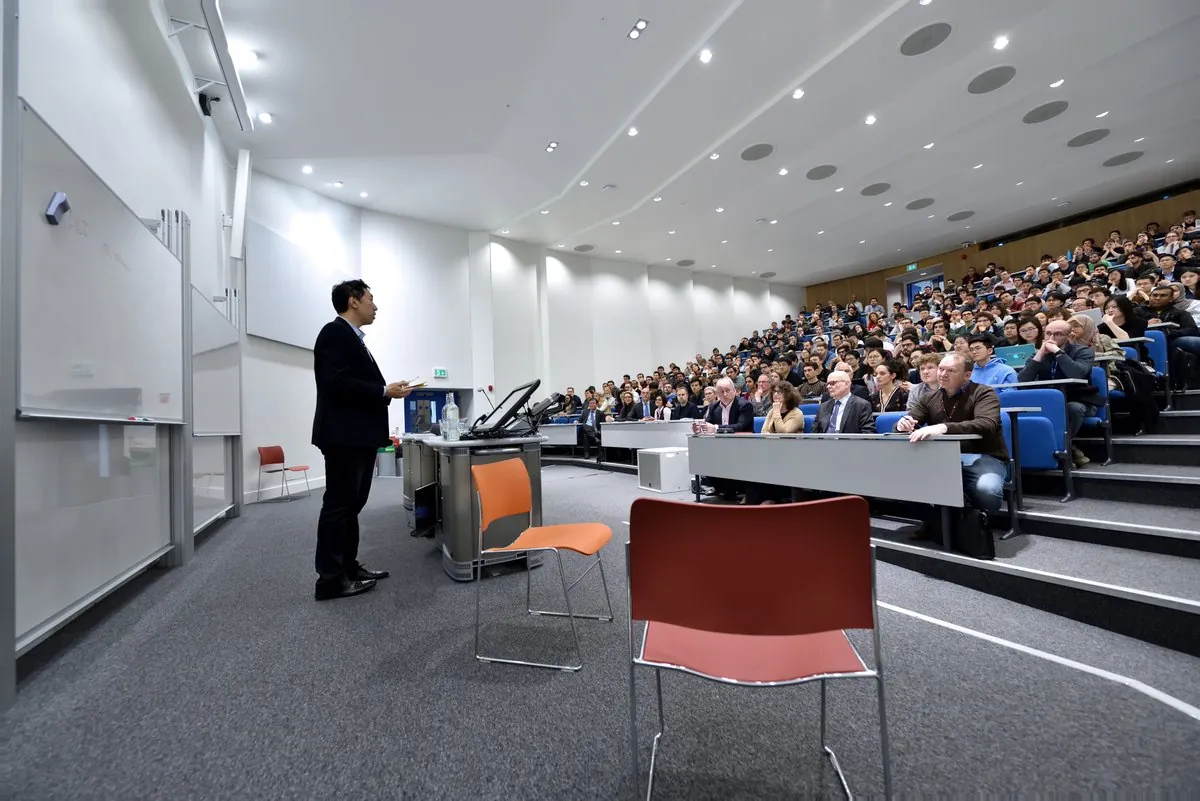
The lecture theatre was full, largely with postgraduate students. Rather than giving a slide presentation, Prof. Ng spoke directly to the audience, using a notebook and the whiteboard to note a few key points. He began by talking about his courses at Stanford University, where he has been rethinking how teaching is delivered. He described his approach, in which students watch videos before class and use the teaching sessions to discuss projects and ideas.
Because he is also working to automate grading, teaching and research assistants can spend more time discussing projects and ideas with students. Other key topics discussed included:
- ANI (Artificial Narrow Intelligence)
- AGI (Artificial General Intelligence)
- Small Data
- Generalizability
- Jobs
- Education
- Creativity
To date, the major progress has been in supervised learning, where an algorithm is trained on thousands, or even millions, of examples before being tested on unseen ones. This form of machine learning underpins most technological applications today.
By contrast, we are still far from achieving AGI, a state in which an agent can make decisions on its own. The human brain is a highly complex system, and although much progress has been made in neuroscience, a full understanding of how the brain works remains a challenging area of research.
Another interesting part of the discussion concerned small data. Machine learning algorithms are generally data-hungry, and it is very hard to work with small data sets. For example, with access to millions of medical images, we can predict well whether a patient has, say, cancer. But what would we do with only ten images?
Algorithms tend to be highly specific. For example, an algorithm designed to predict the market value of one type of object is unlikely to work out of the box on a very similar problem. Although methods such as domain adaptation and transfer learning are being explored, Prof. Ng believes we are still far from building generalisable algorithms.
Job security is a hotly debated topic. While some believe that robots will take over our jobs and leave people unemployed, others expect a radical change in the nature of jobs themselves. Prof. Ng suggested, for example, that in some jobs half of the work may be done by robots while a human presence is still constantly required. As an example, he noted that robots remain far from performing tasks such as cutting hair.
Education matters. To move forward and embrace AI, we must develop our skills so that we can thrive in a rapidly changing environment. Education allows us to harness the talents of brilliant people, and a global online education system not only promotes learning but also gives people who cannot afford university fees access to world-class learning materials.
One audience member asked: what is creativity? Prof. Ng humbly replied, 'I don't know the definition of creativity'. He explained that when his group publishes a paper, people often describe the work as creative, but admitted that the work in the lab is often far less orderly than it appears, especially with deep neural networks, where one has to find the 'right' architecture and tune the hyperparameters carefully.